No more manual analysis. Meet Tara, your AI Product Analyst.


Product teams don’t suffer from a lack of data. They suffer from a lack of time, clarity, and follow-through.
You ship features, launch experiments, and roll out updates… then the real work begins. Someone has to watch sessions. Someone has to find issues. Someone has to make sense of what’s happening. Someone has to decide what matters. Someone has to turn insights into actions.
That “someone” is usually you.
Tara AI changes that.
She is an AI product analyst that joins your team and takes over the manual, repetitive, and time-consuming work: watching sessions, spotting issues, identifying patterns, surfacing anomalies, and turning all of that into clear insights and concrete next steps.


Not summaries. Not dashboards. Not more noise.
Real answers. With evidence. And a plan.
Your newest teammate doesn’t just observe; she acts
Today, most product teams lose hours every week to manual analysis. You carve out time to sit through recordings, hoping to stumble upon an "aha!" moment, but you walk away with surface-level guesses and a massive headache from the grind.
The problem? This manual review process is fundamentally flawed: it is time-consuming, offers low coverage, and often delays critical decisions. You are left wondering if a drop-off is a systemic issue or just a one-off outlier, and without a clear direction, you're forced to guess what to fix first.
Tara changes this. She works like an product analyst on your team, continuously reviewing real user behavior by watching session recordings, spotting problems, and turning those patterns into clear insights. She handles the "eyes-on" work you don't have time for, compressing a two-week research sprint into seconds.
Instead of digging, tagging, and guessing, you simply ask:
“What are the biggest frictions in our checkout right now?”
“Why are users dropping off during signup?”
“Where are users getting stuck in the app?”
“What should we fix first?”
Tara handles the manual labor so you can focus on the strategy:
Eliminate manual review. Tara analyzes sessions in parallel, identifying the main frictions and anomalies without you having to watch a single video.
Understand the "Why," not just the "What": Instead of raw metrics, Tara explains the visual reality behind user behavior so you know exactly what needs attention.
Receive an action plan, not just a summary. You can identify the "why" behind user drops and receive a hypothesis with a recommended strategy.
Verify insights with evidence-based data. Tara is trained to say "I cannot answer" when data is missing, always providing the visual evidence you need to verify her insights yourself.


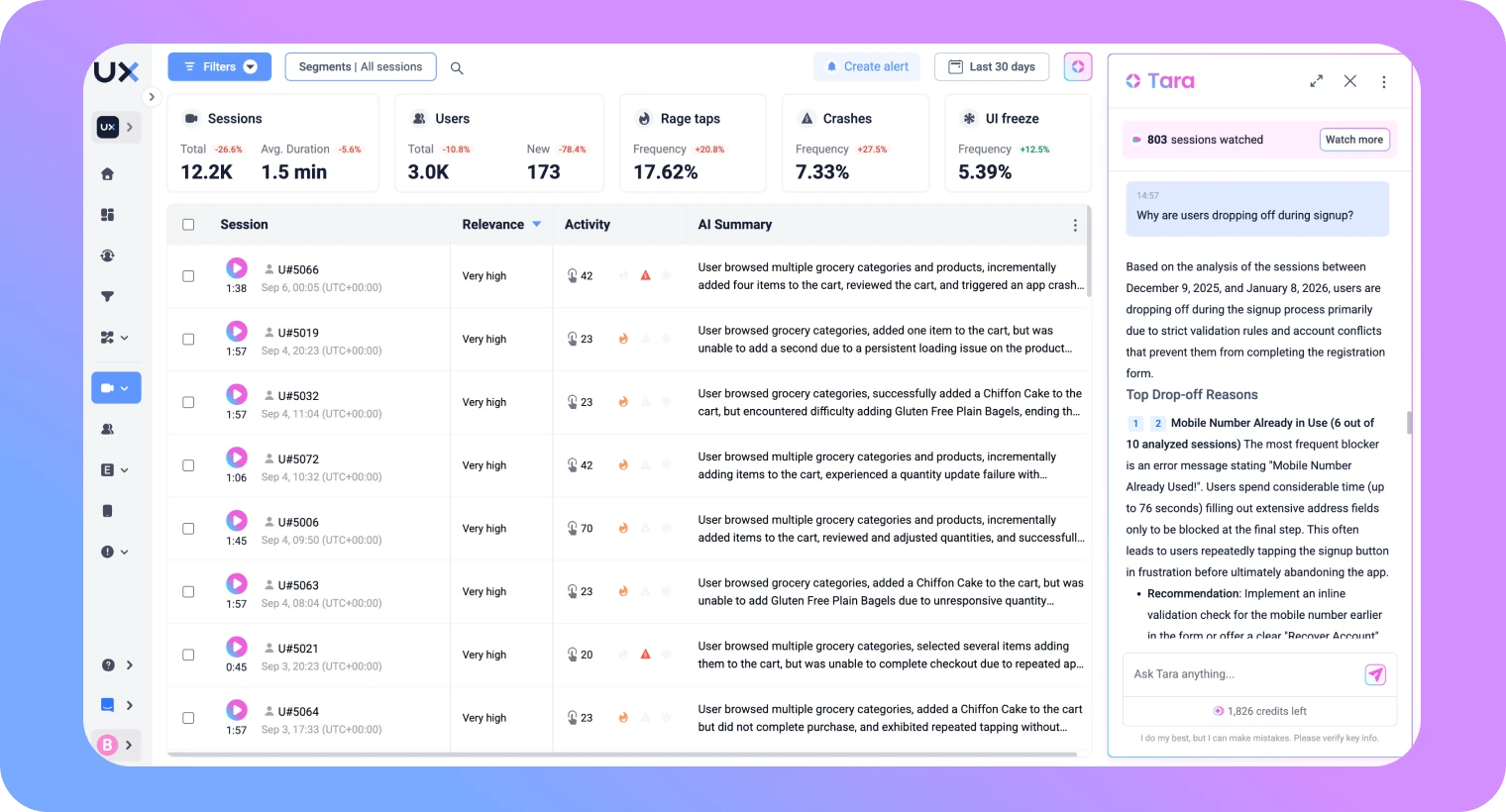
Tara finds what other tools can’t
Most AI tools rely on logs, events, and predefined tracking. Tara doesn’t. She watches real user sessions to understand what people actually see, try, hesitate on, and struggle with.
This allows her to detect issues that never get logged; confusing UI states, broken layouts, hidden buttons, frozen screens, or flows that simply don’t make sense. You don’t have to predict what to track in advance. Tara finds the problems you didn’t know to look for.


Built for answers you can trust
Tara isn’t designed to sound confident, she’s designed to be correct. If she doesn’t have enough data to support a conclusion, she will tell you.
When she does provide an answer, she backs it up with real session recording evidence and direct links to the exact moments that led to her conclusion. That means your team never has to blindly trust a black box. You can verify everything yourself.
From insight to action
Most tools stop at “here’s what happened.” Tara goes further.
She explains why issues occur, how they impact users, and what your team should do next. Every analysis is designed to help you make a decision, not just observe a pattern.
That’s what makes her a teammate, not a tool.
If you need to review a lot of sessions, Tara speeds up this process and makes it easier to get valuable insights. - Rafael Jose Mancera, Product Designer at Rappi.

Why Tara is different from traditional tools
Most product tools are built to observe. Tara AI is built to analyze.
Traditional analytics and AI assistants depend on what you’ve already defined; events, tags, funnels, and dashboards. They can only answer the questions you already thought to ask. Tara works like a real product analyst: she watches how users actually experience your product, identifies what matters, and tells you what to do next.
Here’s the difference:
| The old way | The Tara way |
|---|---|
| Reactive analysis Only answers the questions you already know how to ask | Proactive discovery Surfaces issues and patterns you didn’t know to look for |
| Manual work You dig through dashboards, sessions, and reports | Delegated analysis Tara does the digging for you |
| Observation only Tells you what happened | Decision support Explains why it happened and what to do next |
| Uncertain conclusions Hard to verify or trust | Evidence-backed answers Every insight is grounded in real user behavior |
Tara AI doesn’t just show you data.
She takes responsibility for understanding it.
Tested where it matters most
Tara is already helping teams across complex industries answer questions that usually take weeks of manual analysis, coordination, and guesswork.
Here are a few examples of how product teams use her today:
Fintech: Pre-mortem for new releases Teams use Tara to analyze the first real user interactions after launching a new feature. She catches silent friction in KYC flows, payment steps, or verification screens within hours, before it impacts retention or triggers support spikes.
E-commerce: Conversion diagnosis, not just drop-offs Instead of guessing why users abandon checkout, teams ask Tara to analyze hesitation, confusion, and UI friction. She explains why people leave and what to fix first.
Healthcare: Sensitive flow optimization Tara helps teams identify where users rage-tap, hesitate, or abandon OTP verification and onboarding flows, surfacing emotional friction that dashboards can’t capture.
SaaS: Product discovery & onboarding clarity Teams ask Tara to summarize how users mentally model a new feature. She reveals confusion loops, unintended usage, and unclear value props; replacing manual interviews.
Market expansion: Localization & market-fit analysis Tara compares how different regions or user tiers experience the same flow. She identifies localized friction like address formats, currency confusion, or UX mismatches that traditional analytics miss.
Support-to-product loop: Instant repro-cases Teams paste a user ID from a ticket and ask Tara to show what the user actually experienced before reporting an issue. What used to take days now takes seconds.
These aren’t edge cases.
This is everyday product work; done faster, with clarity.
How Tara fits into your workflow (FAQ)
Does Tara replace my current analytics dashboards? No. Tara is a qualitative product analyst, not a quantitative reporting tool. She doesn’t replace funnels, cohorts, or retention charts; she works alongside them. Use dashboards to see what is happening. Use Tara to understand why and what to do next.
Can Tara find issues we haven’t explicitly tracked? Yes and that’s one of her biggest strengths. Tara AI analyzes real user sessions, not just predefined events. That means she can detect friction, confusion, and broken experiences even if no one thought to tag them.
How is this different from other AI tools? Most AI tools rely on metadata: logs, events, and transcripts. Tara watches the actual user experience. She sees what people try to do, where they hesitate, what confuses them, and where things silently fail. This allows her to catch problems other tools miss.
What kinds of problems does Tara solve best? Tara is especially strong at:
Explaining why users drop off or abandon flows
Detecting hidden usability issues that don’t trigger errors
Revealing how users actually move through your product (not the happy path you designed)
How much time does Tara really save? A lot. Teams typically spend 30–60 minutes watching recording just to find a few insights, days to analyze the findings and more days to create action plan. Tara does that analysis in parallel—across many sessions—and returns the findings, insights and action plans directly to you. What used to take months now takes minutes.
Can I use Tara for high-stakes moments like launches or incidents? Yes. You can ask Tara to analyze specific segments on demand, like a new feature release, a specific market, or even a single user tied to a support ticket. This lets you focus on what matters right now, not generic trends.
What happens when I ship something new? Do I need to reconfigure anything? No. Tara works off your existing recordings. That means you can ask questions retroactively about new features without waiting for a dev sprint, tagging, or setup.
Does Tara really give action plans or just more data? Tara is designed to move your workflow from insight to action. She doesn’t just describe what happened—she explains why, shows the supporting evidence, and recommends what to do next.
That’s what makes her a teammate, not a tool.
Stop analyzing. Start deciding.
Product teams don’t need more data.
They need clarity, confidence, and momentum.
Tara takes over the manual work; watching sessions, finding issues, connecting patterns, and turning all of that into clear insights and next steps. She helps your team move faster, align better, and make stronger decisions, without adding another tool to manage.
She doesn’t replace your team.
She becomes part of it.
If you’re tired of guessing, debating, and waiting for answers, it’s time to meet your new product analyst.
Meet Tara.
AUTHOR
Silvanus Alt, PhD
Founder & CEO | UXCam
Silvanus Alt, PhD, is the Co-Founder & CEO of UXCam and a expert in AI-powered product intelligence. Trained at the Max Planck Institute for the Physics of Complex Systems, he built Tara, the AI Product Analyst that not only analyzes user behavior but recommends clear next steps for better products.


Related articles


News & Trends
Are the New iOS 15 Features a Game Changer for Mobile UX?
Apple is calling iOS 15 their “biggest update ever”. Let’s dig into the most ground-breaking iOS 15...


Marilyn Wilkinson
News & Trends
No more manual analysis. Meet Tara, your AI Product Analyst.
Tara analyzes session recordings, finds friction, explains why it happens, and recommends what to do next; backed by...
Silvanus Alt, PhD
Founder & CEO | UXCam


News & Trends
Leverage QR Codes to Boost Your Mobile Marketing
QR codes offer a cost-effective way to leverage mobile marketing to drive customer engagement and...


Akshay Deogiri
What’s UXCam?