

Today, UXCam becomes the product we always wanted for ourselves.
Not a place to record sessions and hope someone finds time to watch them back, but a place that watches them for you and shows you the highest-impact opportunities.
This is UXCam 2.0, and it’s the biggest shift we’ve made since we started the company.
Is there a pattern emerging? I would like to just have that pattern given to me.
This is exactly why we built UXCam 2.0. Nobody wants another dashboard, or more recordings to sift through to find out why their users aren’t converting. Product teams want the pattern, handed to them, so they can walk into every meeting with the answers.
What’s new in UXCam 2.0
So here’s what’s shipping.
Self-serve insights
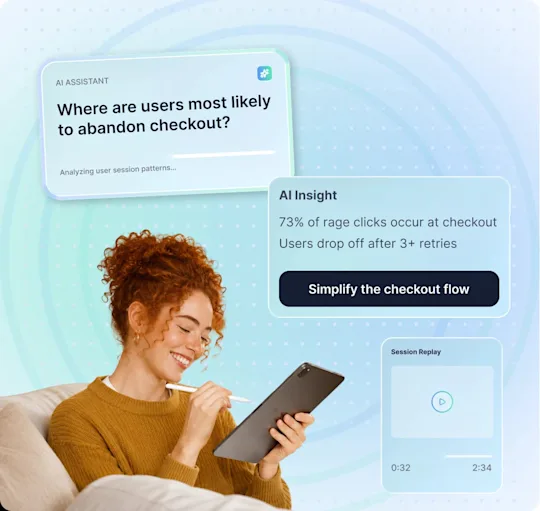
Just ask Tara a question, such as “why did onboarding completion drop last week?”, and get an answer in minutes, grounded in real session replays. No SQL, no ticket to the data team.


Proactive monitoring
Tara keeps watch over your key flows. Set up a routine and she checks them on your schedule, then tells you what moved and why, whether that’s a conversion drop, a frustration spike or a surge in errors. You hear about it on Monday morning, not weeks later when someone finally asks.


Impact-driven prioritization
Instead of a backlog decided by opinion or whoever argues loudest, Tara shows what’s worth fixing by how many users it affects, with the evidence attached to each one.


Stakeholder alignment
Turn an insight into a shareable, evidence-backed report. Describe what you need and Tara builds the dashboard and sharable assets, instead of you spending an afternoon on a deck to convince a director.


UXCam 2.0 is the place where product teams stop guessing and start knowing why. That’s what Tara is for.


Why this matters
Nobody builds a product to spend their week waiting. Product leaders don’t wake up wanting to file a ticket to the data team and check back in three days. They want to know why a number moved, fix it, and move on to the next thing.
But that’s not how it’s worked. Something drops — activation, checkout completion, whatever the metric is that your job depends on — and the next step is usually: wait. Wait for an analyst. Wait for someone to build the dashboard. Wait for someone to interpret the dashboard. By the time the answer arrives, the damage is already done, and the leadership meeting where you’re supposed to explain it has probably already happened.
That’s the problem UXCam 2.0 was built to solve. You don’t need a bigger data team. You need someone already watching.
How we got here
Tara didn’t start as a plan to build an AI product. It started with a much smaller, more specific frustration: product managers already knew session replays were valuable. They just didn’t have the time to watch them.
Before Tara, that meant irregular, spot-check analysis. A PM opening a handful of sessions when something looked off, applying complex filters, hoping to land on the right one. It’s slow, it’s inconsistent, and it means the “why” behind user behavior often just doesn’t get found. Roadmaps get built on incomplete evidence, or on whoever’s hunch was loudest in the room.
We built Tara to close that gap: an AI that does the watching for you, and hands back an answer instead of a pile of footage. Not a replacement for the team, but more like a co-pilot. An “incredibly credible” one, we hope, because every insight Tara gives comes with the evidence attached: the actual session, the actual graph, something you can check against the raw data yourself. You’re still the driver. Tara just stops you from having to do the driving and the watching at the same time.
Trust was the hard part, and we didn’t treat it lightly. Every change to the product runs against an evaluation suite of 250 test cases before it ships. A second, more capable model audits a sample of Tara’s answers every day, checking the faster, cheaper model that runs day-to-day. That’s not a detail we’re mentioning for show — it’s the difference between a tool people believe and a tool people stop using.
It’s not only access to all the metadata you capture from the sessions — it’s also watching the videos. The same way a researcher watching ten or twenty session replays can figure out what’s going on, Tara can do exactly the same, only way faster.


Janaina Martins, who walks prospective customers through Tara every week, explains why that matters beyond just saving time:
You don’t rely only on those that give the feedback. They’re usually the ones who are very happy or very unsatisfied with the service. Everyone in the middle, which is the majority, it’s hard to guarantee they’re going to leave feedback at all.
Surveys and reviews only catch the people motivated enough to speak up. Tara catches everyone in between.
We’ve stayed a small team on purpose. It means fewer layers between an idea and shipping it, and it means we get to move faster than competitors with a fraction of our focus and several multiples of our budget.
Daniel Lee, a Senior Product Manager at Virgin Mobile, put it better than we could when he first tried Tara:
Tara highlighted the top issues I would have spent 20 hours reviewing videos to find, and it did it very quickly.
That’s the whole point, said back to us by someone who isn’t on our payroll.
Where to start
This is your invitation. New to UXCam? You can start on UXCam 2.0 today with a free trial. Already a customer? Request early access and our team will get in touch.
The new phase starts now.
AUTHOR
Silvanus Alt, PhD
Founder & CEO | UXCam
Silvanus Alt, PhD, is the Co-Founder & CEO of UXCam and a expert in AI-powered product intelligence. Trained at the Max Planck Institute for the Physics of Complex Systems, he built Tara, the AI Product Analyst that not only analyzes user behavior but recommends clear next steps for better products.


Related articles


Tara AI
How teams use Tara as their AI product analyst
A practical guide on how product teams use Tara as their AI product analyst; from diagnosing drop-offs to prioritizing what to fix next and making better decisions,...


Begüm Aykut
Growth Marketing Manager


UXCam
UXCam Academy: Free Product Management and Analytics Courses With Certificates
UXCam Academy has two free video courses, one on mobile product management and one on product analytics with UXCam. Pass the exam and add your certificate to...


Jonas Kurzweg
Product Analytics Expert


Product Management
The Best Product Management Resources in 2026: Courses, Newsletters, Communities, Podcasts and Books
Product management resources we checked in October 2026: free courses with certificates, newsletters, communities, podcasts, books and conferences, with what each...


Kayleigh Alexandra
What’s UXCam?


